Genesis: The Scientific Quest for Life's Origin (2005)
Chapter: Prologue
Prologue
“Look at this!”
Harold Morowitz beamed as he hustled into my office. “The dielectric constant of water drops to about 20 at a kilobar and 350 degrees. That’s like an organic solvent!” He pulled up a chair to show me the data.
It took me a moment to change gears and realize what he was so excited about. Harold and I both teach undergraduate science courses at George Mason University, where we often discuss biology’s “Big Questions,” including the chemical processes that might have led to life’s origin. For more than two decades Harold had puzzled over the role of water, which poses a persistent problem in origin-of-life scenarios. Water is the medium of life, while carbon, by far the most versatile of all the chemical elements, forms the essential backbone of all biomolecules. Yet researchers find that several key chemical steps in assembling life’s carbon-based molecules do not work very well in water. So how could life have started on a wet planet?
One intriguing, though untested, possibility is that life’s initial chemical reactions proceed more easily at high pressure and temperature. This idea had received a boost in the late 1970s, when Oregon State University oceanographer Jack Corliss descended to the deep, dark ocean floor in the research submersible Alvin and observed astonishing ecosystems at undersea volcanic vents. In these hellish zones, without benefit of sunlight, life has found a way to survive crushing
pressures of 1,000 atmospheres—a kilobar—and scalding temperatures greater than 100°C. Perhaps, Corliss and co-workers suggested, life first arose at such hostile extremes, and in total darkness.
Morowitz’s dense tabulation held a possible clue. Photocopied from a 1970s text, it recorded variations of water’s physical and chemical properties with temperature and pressure. Sure enough, at extreme pressure-cooker conditions water appeared to be a remarkably different liquid from the stuff that comes out of the tap. Harold was onto something. “So maybe Jack Corliss is right—maybe it is the vents.”
The mainstream origin-of-life community, wedded as they were to the tradition of a globe-spanning ocean of “primordial soup” bathed in sunlight, had rejected this speculation out of hand. In the intervening two decades, no one had bothered to try the relevant high-temperature and high-pressure experiments. Yet the so-called hydrothermal-origins hypothesis was too intriguing and too testable to disappear. In the late 1980s, the German chemist and patent attorney Günter Wächtershäuser put flesh on the bones of this idea by proposing a detailed chemical scenario for origin events in a deep hydrothermal zone rich in sulfide minerals.
Now Harold had uncovered data showing how the physical and chemical properties of water might be very different at extreme conditions from those of everyday experience. Perhaps chemical reactions that fail at Earth’s ordinary surface conditions could take place at those extremes. There was only one way to find out.
“So, can you do the experiments?” Harold knew that my nearby research base, the Carnegie Institution’s Geophysical Laboratory in Washington, D.C., maintained an arsenal of high-temperature and high-pressure apparatus. The laboratory specialized in chemical reactions at extreme conditions, so he hoped that my colleagues and I might be able to tackle the complex carbon chemistry that underpins the origin of life.
I hardly gave it a second thought. “Sure, why not? It’s an easy experiment.” I had no idea where that hasty promise would lead.

Harold Morowitz is one of the kindest scientists I know. More than a few scientists wear a veneer of kindness—a pro forma geniality that masks an intense and often competitive personality. Those of us whose
lives are devoted to indulging our curiosity tend to be a distracted, self-absorbed lot. Harold is different. He smiles winningly at the slightest encouragement and speaks with the calmness and quiet passion of a rabbi or father confessor. He loves a good idea, and shares his richly inventive vision of life’s origin without hesitation, without the conventional expectation of clever reciprocation. He came to George Mason University in 1988, after a full and productive career on the biology faculty at Yale, where he made his mark studying energy flow in cells. Harold argues persuasively that modern cells carry hints of life’s earliest biochemical processes. Such molecular “fossils” persist in all of us in all our cells he claims, and these molecules point to the chemistry of life’s origins. [Plate 1]
Although at the time a novice at origins research, I was delighted for an excuse to collaborate with Harold Morowitz. His name provided instant credibility in a field at times tarnished by questionable data, contentious debates, or even outright quackery. Nevertheless, a successful experiment must be planned with care, and Harold had already spent a lot of time thinking about strategy.
“Let’s start with pyruvate,” he urged. Pyruvate, an energy-rich, 3-carbon molecule, was a natural choice for Harold, who had spent a lifetime studying metabolism, the processes by which cells gather atoms and energy to sustain themselves, grow, and reproduce. Pyruvate is a key ingredient in every cell’s metabolism. Most cells gain energy by splitting the 6-carbon sugar, glucose, into two pyruvate molecules, after which the pyruvate is broken into smaller molecules to release further energy. Morowitz explained that some cells also use pyruvate as a building block to construct larger molecules. So, for example, a pyruvate molecule and a molecule of carbon dioxide (one carbon atom bonded to two oxygen atoms) can react to form a 4-carbon molecule called oxaloacetate, which undergoes further reactions in metabolism.
It’s simple math: 3 + 1 = 4. But that reaction never works in water at room pressure, at least not without a complex biological catalyst—a molecule that greatly boosts the reaction rate. In the absence of a cell’s sophisticated catalytic chemical machinery, pyruvate tends to break down into fragments with only one or two carbon atoms. Perhaps, Harold suggested, higher pressure and temperature would reverse this trend and induce pyruvate plus carbon dioxide to form oxaloacetate. If so—if we could demonstrate that hydrothermal conditions promote such a key metabolic reaction—then hydrothermal vents would be-
come even more of a focus for the origin of metabolism. Experimentalists dream of such opportunities—a simple experiment with a big potential payoff.
We agreed on a range of temperatures from 150°C to 300°C and pressures from 500 to 2,000 atmospheres—conditions relevant to hydrothermal systems at and below Earth’s deep-ocean floor. But achieving such conditions is easier said than done.
It was time to pay Hat Yoder a visit.
Every scientific career rests on the support of colleagues who act as teachers, collaborators, and employers. In my career, Hatten S. Yoder Jr. served in all three roles. He is my scientific hero. Burly, handsome, with big, powerful hands, Hat built his high-pressure lab at Carnegie’s Geophysical Laboratory from scratch, shortly after returning from action with the Pacific Fleet in World War II. For more than half a century, he maintained this premier facility, working tirelessly in his quest to understand the origins of rocks. [Plate 1] Even at the age of 75, I knew he would jump at the chance to try something new.
“What P and T?” he asked.
My response was somewhat sheepish. Hat’s pressure lab was designed to achieve extreme conditions: pressures of 10,000 atmospheres at more than 1,000°C. Running our proposed experiments at a measly 2,000 atmospheres and 250°C would be like using a blast furnace to bake a cake. But an experiment is an experiment, and after only the slightest raising of eyebrows and barely audible “hmmph!” Hat was ready to go.
High-pressure experiments are not for the faint of heart. Even at pressures of only a few atmospheres, hot gas can cause a nasty explosion. Your pressure cooker sustains no more than a pressure of 2 atmospheres, your car’s tires less than 3, and both can blow out violently. Hat’s home-built device, aptly called a pressure bomb, worked at thousands of atmospheres with a volume about the size—and with the same explosive power—of a stick of TNT. A catastrophic, explosive failure at those pressures could knock out a corner of the lab building. But no such worries attached to the pyruvate project.
Our experimental strategy relied on a classic metal-capsule technique for studying chemical reactions at high temperatures and pres-
sures: Simply seal reactants into tiny cylindrical gold tubes about the size of a large grain of rice. The soft, chemically inert gold crushes down on the reactants, providing an isolated high-pressure, high-temperature environment.
We crafted our capsules from a cylinder of gold a foot long, like a precious soda straw. I cut the cylinder into 1-inch lengths and welded each piece shut at one end. Water and pyruvate, both liquids, loaded easily into the capsules with a syringe—50 milligrams of water and 3 milligrams of pyruvate, just a droplet. It’s difficult to weld shut a tube containing a gas, so we adopted an old experimental trick and used a white powdered chemical called oxalic acid dihydrate, which breaks down to water plus carbon dioxide above 100°C.
My first attempts at welding the gold tubes shut were a mess. I weighed and loaded the reactants, crimped shut the tube’s open end, and placed the gold capsule into a vise, with the crimped end peeking out above thin steel jaws. A successful weld requires one smooth flick of the wrist with a carbon-arc welder, a graphite rod the size of a pencil that carries an intense electrical current. The gold is supposed to melt and flow, zipping up the capsule in a fraction of a second. But as my welder heated the gold, a portion of the volatile pyruvate boiled away. A sudden burp of smelly gas blew an ugly, gaping hole in the weld, ruining the carefully weighed ratios of reactants. After a lot of trial and error, I learned to weld one capsule end (using a microscope to see what I was doing), while the other end was immersed in ultracold liquid nitrogen, a frigid −196°C bath that froze the volatile reactants. The welder would erupt into blue-white flame and the gold would sputter and melt, sealing the tube. Eventually my batting average rose above 0.500.
Hat inserted three identical gold capsules into a platinum holder inside a foot-long nickel metal cylinder that would serve as an electric furnace. Decades of experience streamlined his routine. After the capsules are inserted, load the cylinder with ceramic filler rod, thermocouple wires, and ceramic end cap, and pack it all with a fine, sandlike powder of white aluminum oxide. Attach that sample assembly to the “head,” a fat steel plug that holds in pressure while providing insulated channels for wires that carry electric current for the heater and tem-
perature sensors. Insert the cylinder and head into the massive metal bomb. Seal the bomb with a giant 6-inch-long nut with a 6-sided head. Tighten the nut with a 3-foot-long 20-pound wrench; use a 3-foot-long pipe as an extension for added torque.
Hat banged away at the unwieldy wrench, making a horrendous racket as he tightened the nut just a bit more for safety. “It’s always good to make a lot of noise in the lab,” he said. “That way the director will know you’re working.”
We retreated behind a wall of battleship gray, war-salvage naval armor as Hat opened and closed a bewildering sequence of valves to fill the system with pressurized argon, an inert gas. Ka-chunk, ka-chunk, ka-chunk! The argon gas compressor pumped the bomb to 2,000 atmospheres in a matter of minutes. Hat set the computerized furnace controls to ramp the temperature up to 250°C, and we were off. Deep inside the steel bomb the gold tubes were being crushed and heated to conditions similar to those found several miles beneath Earth’s surface. In such an extreme environment, the pyruvate was sure to do something interesting. We went to lunch.
Two hours later, we were back in the high-pressure lab to quench the run. When the current shut off, the temperature dropped rapidly, cooling to below 100°C in about a minute or so. Hat released the pressure with a whoosh, unscrewed the big nut, and pulled out the sample assembly. He dumped the cylinder’s contents into a shallow metal tray: end cap, thermocouple, filler rod, platinum holder, lots of fine white sand, and three fat, shiny gold capsules spilled out. Success! The capsules had held! We itched to know what was inside. Two capsules went into the freezer, while I took the third upstairs for analysis.
There is nothing sophisticated about opening a gold capsule; you simply snip open one end and pour out the contents. First I washed the outside of the capsule in organic solvents to avoid any contamination by machine oil or fingerprints. Then I froze it in liquid nitrogen, so that the contents would not leak out during the snip. I positioned the capsule over a glass vial to catch the gold and its contents. Just a little snip … usually does the trick…. Kapow! The gold weld blasted off into some remote corner of the lab, propelled by the sudden release of what must have been several atmospheres of internal gas pressure. A bit shaken, I dropped the capsule into the bottom of the vial, where it lay dormant for a few seconds. But then it began to hiss and foam as a yellow-brown oily substance frothed out, coating the gold
and the glass. A pungent odor not unlike Jack Daniels permeated the lab.
The pyruvate had clearly reacted, but it did not look anything like colorless, odorless oxaloacetate. What had we made?
Time to consult George Cody [Plate 1], a recent arrival at the lab and an organic geochemist trained to analyze messy, oily stuff. George is enthusiastic, loquacious, and—luckily for us—he can’t seem to say no. He is also an expert in the chemistry of coal; he tends to snow visitors to his office with a blizzard of arcane chemical names and reactions. He thinks out loud and scribbles diagrams of molecules and reactions on any available surface, including the protective windows of his lab’s chemical hoods. When I showed him the smelly goo, he knew just what to do.
“GCMS,” he said, “We probably don’t need CI.” I nodded as if I understood what he was talking about. “Let’s use BF3 propanol as the derivatizing agent. The Supelco column should work fine.”
He had proposed that we analyze our suite of products by passing them, together with a chemically inert gas, through a long, thin tube filled with specially prepared organic molecules. This technique, gas chromatography (the “GC” of GCMS), separates different molecules according to how fast they move through the column. In general, smaller, less reactive molecules move faster than bigger, “sticky” molecules. The gas chromatograph sorts a collection of different molecules into separate little pulses, typically over a period of 30 or 40 minutes.
Then comes the mass spectrometer (the “MS” of GCMS), which measures the relative masses of molecules and their fragments. George’s mass spectrometer blasts molecules into lots of smaller pieces of distinctive weights, so each pulse from the GC can be analyzed separately as a suite of characteristic mass fragments, providing a kind of fingerprint of the product molecule.
It took a couple of hours of chemical processing to prepare the concentrated liquid sample for analysis. George filled a syringe with the pale yellow liquid and injected a tiny drop into the GCMS with a practiced, swift motion. We sat back to watch as a spectrum gradually appeared on the computer monitor. The first peak showed up at 10.79 minutes—a small molecule with probably only two or three carbon atoms. Then another peak at 11.71 minutes, and another at 11.96. Faster and faster peaks appeared, piling in on top of each other, every spike representing additional molecular products. By the 20-minute
mark, a broad hump decorated with hundreds of sharp spikes was emerging.
“Humpane,” George muttered in disgust. Pyruvate had reacted in our capsules, to be sure. But instead of the simple 3 + 1 = 4 reaction that Morowitz had proposed, we had produced an explosion of molecules—tens of thousands of different kinds of molecules. Not a trace of oxaloacetate was to be found, but a bewildering array of other molecular species had emerged. It might take a lifetime to decipher the contents of just one such molecular suite.
One conclusion was obvious. Some very dynamic organic reactions proceed rapidly at hydrothermal conditions. In one sense, Morowitz’s hypothesis had failed: Pyruvate doesn’t react with carbon dioxide to form oxaloacetate under those conditions. But we had caught our first glimpse of a robust, emergent carbon chemistry in a hydrothermal environment. This was chemistry worth exploring.
Where to begin? We were faced with choosing from among thousands of simple carbon-based molecules over a wide range of pressure, temperature, and other experimental variables—work to devour a hundred scientific lifetimes.
What were we getting ourselves into?
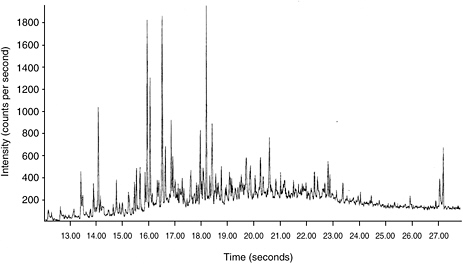
A diverse suite of molecules emerges when pyruvate is subjected to high temperature and pressure. These products appear as numerous sharp peaks superimposed on a broad “humpane” feature on a gas chromatogram.