Touch the Universe: A NASA Braille Book of Astronomy (2002)
Chapter: The Hourglass Nebula
Visit
NAP.edu/10766
to get more information about this book, to buy it in print, or to
download it as a free PDF.
Previous Chapter:
The Ring Nebula
Figure 7.
Next Chapter: NGC 2392--The Eskimo Nebula
Suggested Citation:
"The Hourglass Nebula." Noreen Grice. 2002. Touch the Universe: A NASA Braille Book of Astronomy. Washington, DC: Joseph Henry Press.
doi: 10.17226/10307.
Figure 7.
THE HOURGLASS NEBULA
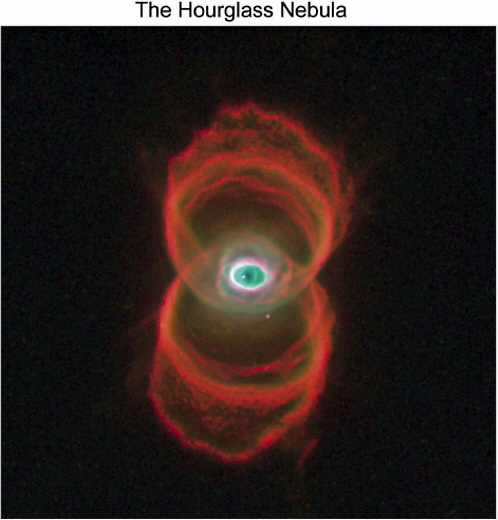
The Hourglass Nebula is a planetary nebula located about 8,000 light years away, meaning that its light takes 8,000 years to reach Earth. A dying star in the center of the nebula is ejecting gaseous material into space. The first astronomers to view this collection of star debris through a telescope thought it resembled the shape of an hourglass, so they gave it that name.
This January 1996 picture, taken by R. Sahai and J. Trauger of the Jet Propulsion Laboratory, reveals the nebula’s detailed wispy structure and a pair of intersecting elliptical rings at the center.
Suggested Citation:
"The Hourglass Nebula." Noreen Grice. 2002. Touch the Universe: A NASA Braille Book of Astronomy. Washington, DC: Joseph Henry Press.
doi: 10.17226/10307.
Suggested Citation:
"The Hourglass Nebula." Noreen Grice. 2002. Touch the Universe: A NASA Braille Book of Astronomy. Washington, DC: Joseph Henry Press.
doi: 10.17226/10307.
Subscribe to Emails from the National Academies
Stay up to date on activities, publications, and events by subscribing to email updates.