Force Majeure: Wildfire and Wheat: Work by Adrien Segal (2020)
Chapter: Force Majeure: Wildfire and Wheat: Work by Adrien Segal
|
CULTURAL |
February 18 - July 15, 2020 |
Force Majeure
Wildfire and Wheat
Work by Adrien Segal
Intoduction
The term force majeure translates to “superior force.” It also refers to a common clause used in contract law to account for extraordinary events such as a natural disaster, an “Act of God,” or any other unforeseeable circumstance that is a result of the elements of nature, as opposed to one caused by human activities such as war. In the 21st century, natural systems have been so drastically affected by human activity that wildfires, floods, and many other extraordinary events, previously identified as natural disasters, can no longer be so neatly categorized. With her Wildfire Progression and Wheat Mandala series, artist Adrien Segal explores the connections and blurring distinctions between the natural and human-caused forces that are changing ecosystems around the world.
Based in Oakland, California, Adrien Segal works across disciplines and media, drawing upon history, narrative, emotion, and perception. Her artwork synthesizes information from scientific research in an attempt to bridge the deep disconnect between scientific rationality and the emotional nature of human experience.
This exhibition was organized by Cultural Programs of the National Academy of Sciences.
@CPNAS I #AdrienSegal
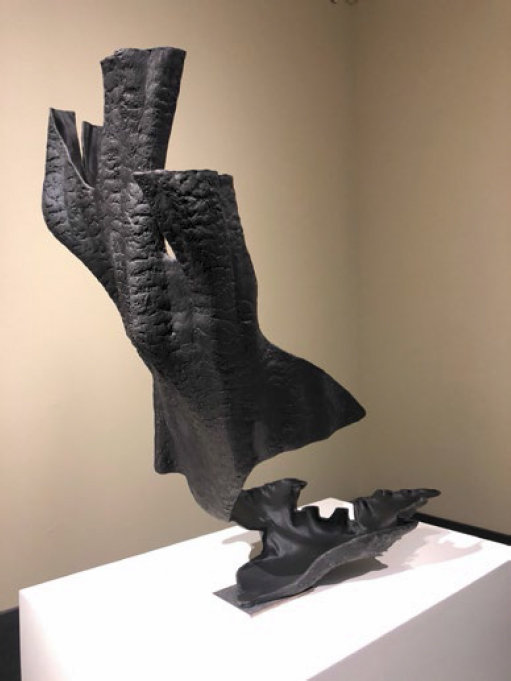
From the Wildfire Progression Series 2018; cast bronze.
On the cover:
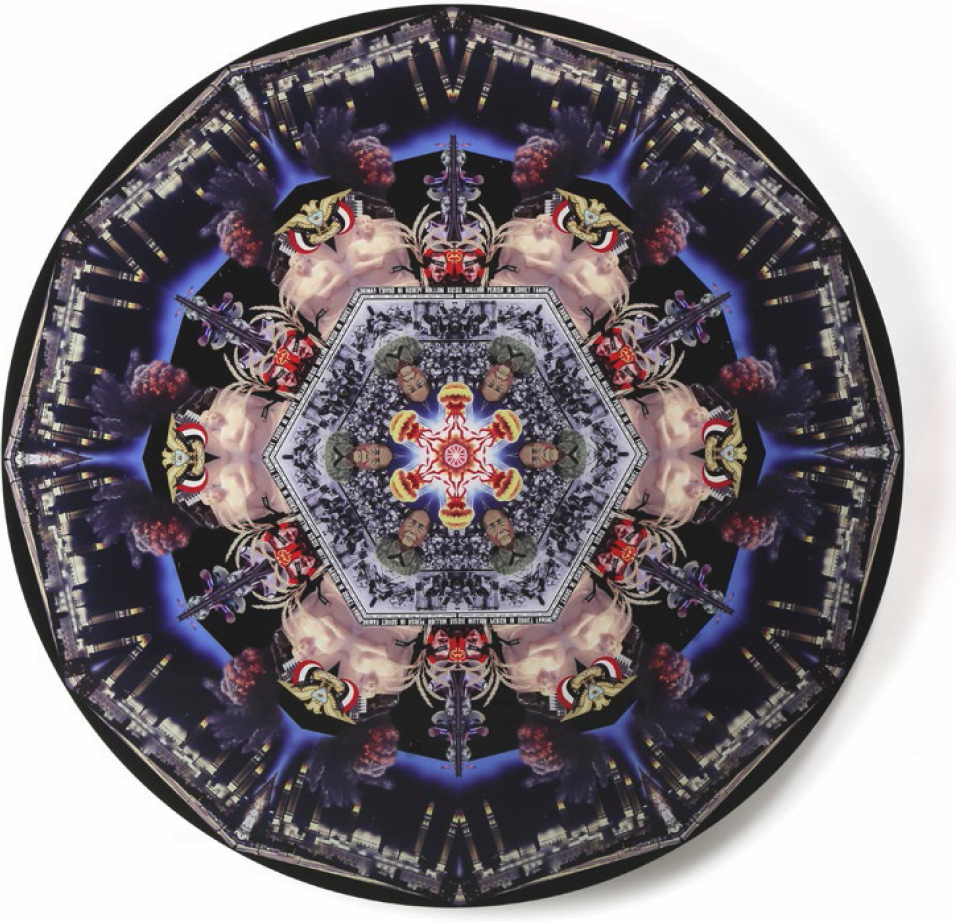
Man-Made Famine
From the Wheat Mandala Series 2018; digital print on acrylic; 30 × 24 × 14 inches.
Adrien Segal: Data Sculptor
By Juliana Biondo
Assistant Curator, World Bank Group Art Program
The scientific process is centered on the elimination of bias in an effort to reveal an objective truth. The artistic process is founded on the celebration of the emotional to showcase the experience of being human on the most personal of levels. One process seeks to strip away subjectivity while the other seeks to delve into its depths. How can these two seemingly opposite worlds cross paths?
In her presentation at the KIKK Festival – a festival promoting cross-disciplinary conversations across art, culture, science and technology – artist Adrien Segal shared a charming graphic. The image was divided into two columns: the left side spoke about how science can be used to clone a tyrannosaurus rex for example, while the right side explained how humanities can be used to tell you why that might not be the best idea. The question of how these two worlds can cross paths is perhaps the wrong one. It is actually that these worlds are two sides of the same coin: our understanding of the world in which we live.
Albert Camus (1913-1960), French philosopher, author and journalist once stated “Art for art sake is not understandable to the masses or else in no way expresses the truth. Art cannot be a monologue.” Bringing it to the current day, Brian Eno, an English musician, record producer, visual artist, and theorist also stated a similar sentiment, “Stop thinking about artworks as objects, and start thinking about them as triggers for experiences.” And yet another world-renowned thinker and maker, Danish-Icelandic artist Olafur Eliasson states “What does looking actually mean? Why am I seeing things the way I am seeing it? Instead of questioning the object, you are questioning yourself. So, art can offer an opportunity for self evaluation.” Each one of these reflections hints at a similar concept: art is not fixed. Art is a phenomenon that yields meaning only through an audiences’ interaction – active looking - with it.
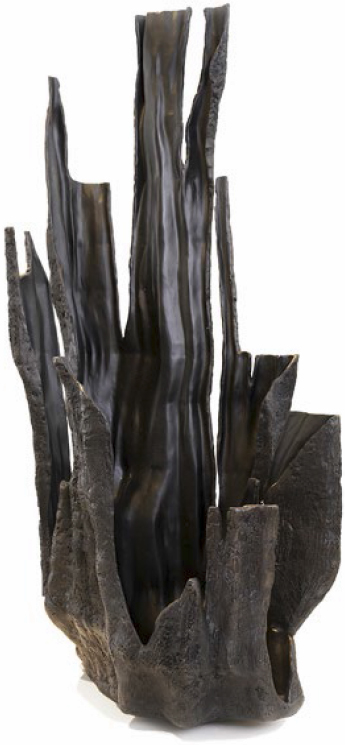
From the Wildfire Progression Series 2019; cast bronze; 27 × 14 × 12 inches.
Artist Adrien Segal found a comparable phenomenon in the scientific world: data.
Data gains its value by the very fact that it records ephemeral moments, and can be endlessly collected over time. While it might freeze a moment of time in the singular sense, it is not static when taken in
the aggregate sense. In the aggregate, data is constantly transformed as it demands context and human analysis to tell a story. What does it take for data to go from total agglomeration to clarified narrative? Segal’s sculptural series, Cedar Fire Progression, visualizes a set of data from the California Department of Forestry Fire and Resource Assessment Program. This dataset is the record for how the Cedar Fire burned from October 25 to December 5, 2003. This fire was the third largest in California history. Segal utilized three-dimensionality to animate the numbers. She did this by visualizing the time data - from 0 to 114, as the fire burned for 114 hours - along an imaginary y-axis and the total areas of the affected land data along an imaginary x-axis. What results is a gorgeous abstracted sculpture racing upwards, as delicate as it is solid. Through the re-presentation of data into a three-dimensional work, Segal allows the viewer to have a physical relationship to the information. The data comes into our space; the narrative it tells is now a part of our personal worlds.
In another one of works, the Wheat Mandala series, the data Segal used did not exist as a series of charts and numbers, but as a wide-ranging collection of materials such as newspaper clippings, historical records, images, headlines, journal entries, and other piecemeal sources. In the work Year Without Summer Segal distills these kinds of informational collages about the volcanic eruption of Mount Tambora of 1815 into a circular kaleidoscopic mandala. Choosing to shape the data into this form was intentional: the mandala is a religious object used to focus one’s attention into a meditative state. In this meditative state, it is thought that a more divinely inspired understanding of the human existence can be achieved. Segal is looking to focus our attention around our own processes of scientific inquiry and learning. How do we sift through non-linear information? What do we allow to capture our attention? How do we decide to focus our energy when learning about something previously unknown to us? Segal proposes that these questions are worth confronting.
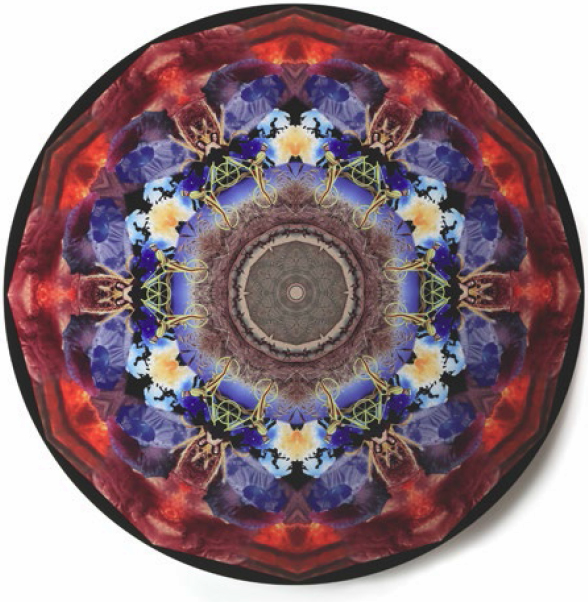
From the Wheat Mandala Series 2018; digital print on acrylic; 40 inch diameter.
In Segal’s hands data drives the creation of new artistic forms. These forms stand as testimony to an ever-maturing relationship between information and its tangible visualization. In the end, Segal’s works are in fact triggers. She expertly reveals one narrative just to then make us wonder how many more there really are.
Wildfire Progression Series
Based on the Cedar, Rim, and Camp Fires in California, Adrien Segal created the sculptures and drawings on view using data about the shape of the wildfires as they expanded geographically over time. Wildfire is a natural phenomenon that is a necessary process for a healthy forest ecosystem. At the same time, it can be very harmful and destructive to humans. With her work, Segal examines these opposing perspectives, and brings attention to the dissonant forces at play in wildland areas that have regularly burned throughout history, and are increasingly being developed by humans, whose presence in turn disrupts the wildland ecology.
We might think of wildfires as natural disasters, but in reality, as many as 90% of wildfires are caused by human activity, the result of campfires left unattended, the burning of debris, downed power lines, discarded cigarettes, or arson. The remaining 10% are caused by chance occurrences such as lightning strikes. The size and severity of the fires are being exacerbated by persistent heat and drought, the result of human-caused climate change.
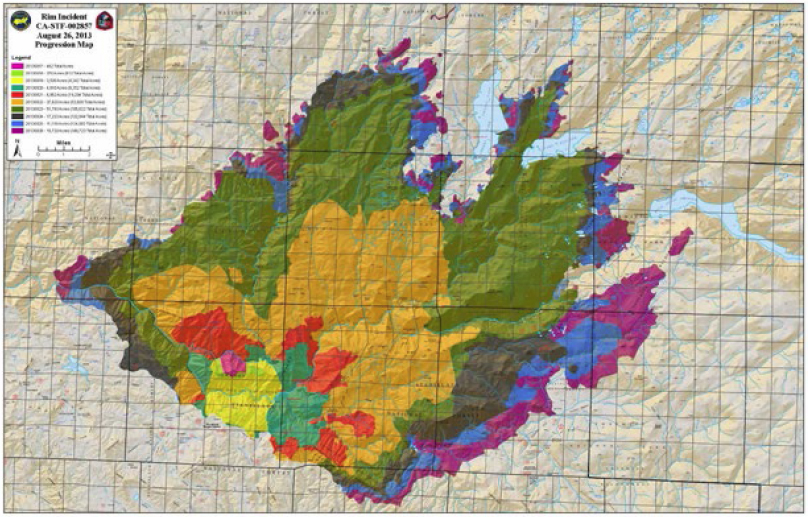
To create the works, Segal sourced data from the California Department of Forestry Fire and Resource Assessment Program’s fire progression maps of the Rim Fire, Stanislaus National Forest, CA; the Cedar Fire, San Diego County; and the Camp Fire, Butte County.
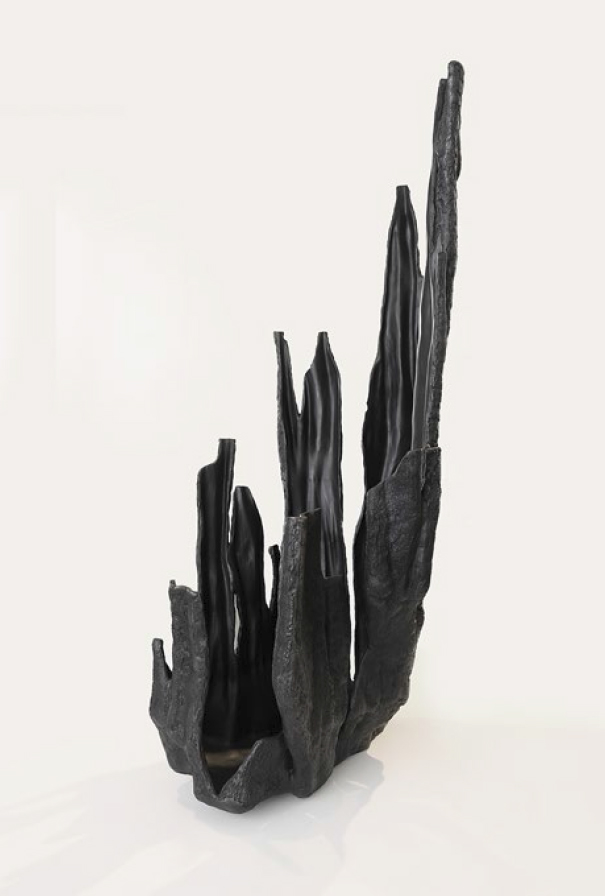
From the Wildfire Progression Series, 2019; cast bronze; 27 × 14 × 12 inches.
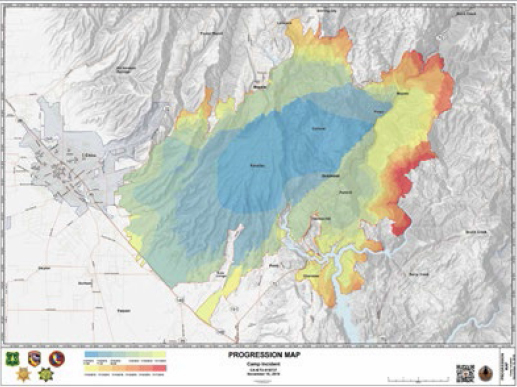
The Camp Fire was ignited by a faulty electric transmission line in Northern California on November 8, 2018. An easterly wind drove the fire downhill through the town of Concow and became an urban firestorm in the foothill town of Paradise. (A firestorm is a conflagration which attains such intensity that it creates its own wind system.) The towns of Paradise and Concow were almost completely destroyed, each town losing nearly 95% of its structures. The rapidly spreading fire caused, at minimum, 85 civilian fatalities. Largely driven by extreme weather conditions — high winds and low humidity — the fire was fueled by brush parched by more than 200 days without significant precipitation, part of a state-wide drought related to climate change. Paradise, which typically receives five inches of autumn rain by November 12, had only one-seventh of an inch of precipitation at the firestorm’s onset.
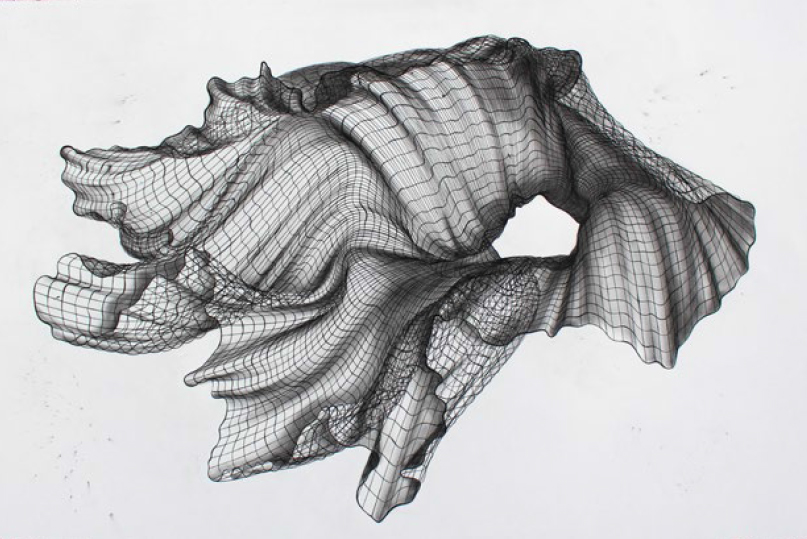
From the Wildfire Progression Series, 2020; ink and charcoal harvested from Rim Fire wood on paper; 26 × 40 inches.
The Rim Fire started in 2013 when a hunter lost control of an illegal campfire in a remote canyon in the Stanislaus National Forest just outside of Yosemite National Park. The fire doubled in size overnight and within four days had consumed 100,000 acres. The fire’s rapid spread was attributed to a record-breaking drought, a heat wave, past fire suppression efforts that had altered the normal fire regime, population growth, and Forest Service budget cuts. The artist gathered some of the charred wood from the area of the Rim Fire and made her own ink using the charcoal, which she used to create this drawing.
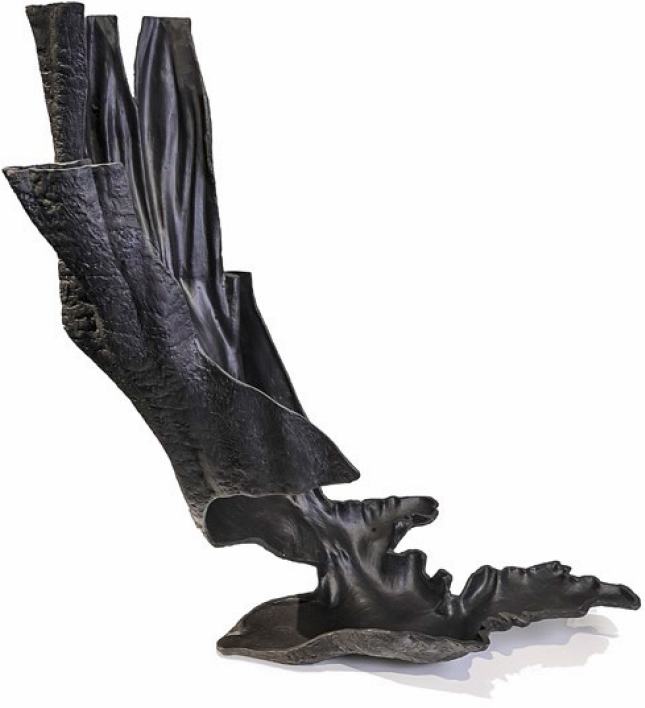
From the Wildfire Progression Series 2016, cast bronze, 30 × 24 × 14 inches.
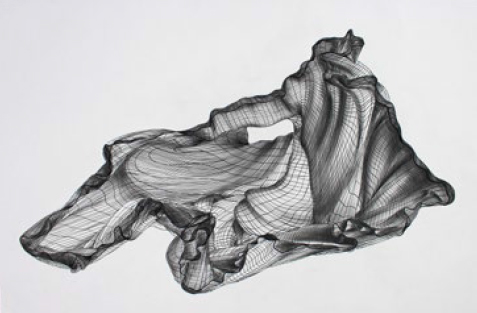
From the Wildfire Progression Series, 2016
India ink and charcoal on paper; 26 × 40 inches.
This drawing and the related sculpture are two iterations of the same fire event interpreted through different media. Adrien Segal originally created this drawing from a birds-eye view of the fire’s progression as a CAD (Computer Aided Design) model, rendered geometrically as a three dimensional surface defined by contour lines and shading. She then rendered the drawing by hand, resulting in the work you see here. Segal meticulously inked the lines with freehand brush strokes and carefully built up shaded areas with charcoal to create a sense of depth.

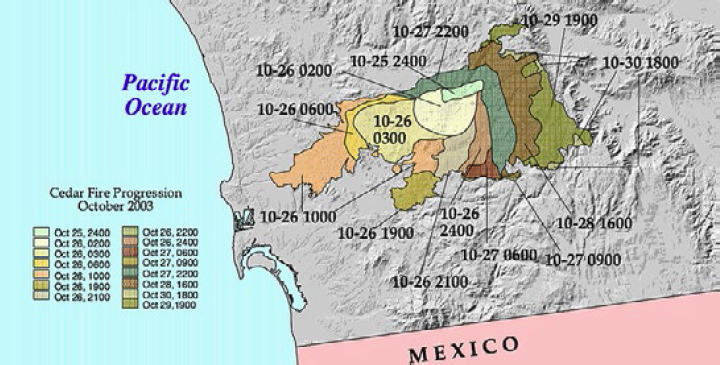
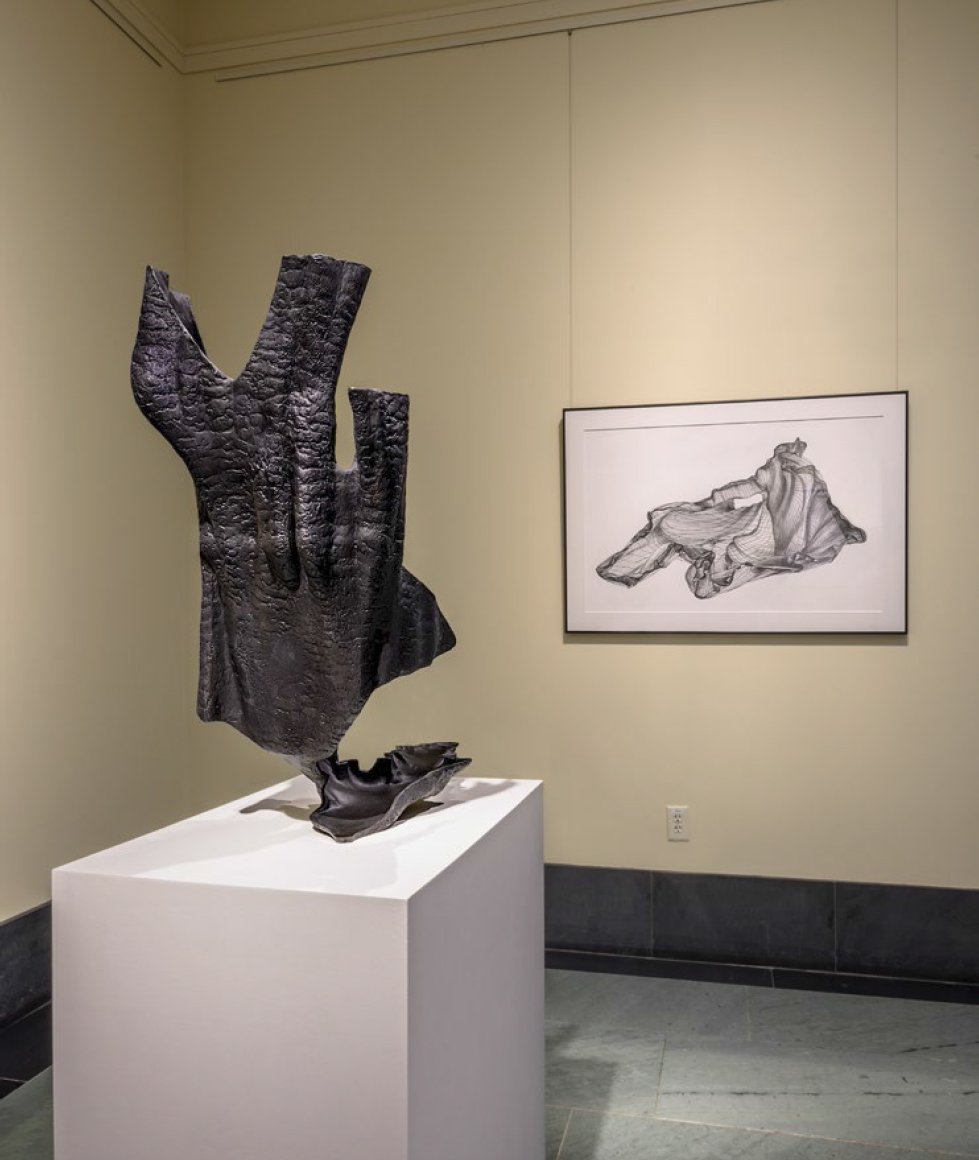
This sculpture embodies the shape of the Cedar Fire as it expanded geographically over the first 114 hours that it burned. This wildfire was part of the “2003 Firestorm” event in San Diego County and, at the time, it was the largest recorded wildfire in California’s history. The fire was intentionally started by a novice hunter who became lost and wanted to signal rescuers. Due to the heat, low humidity and moisture, and high winds, the hunter quickly lost control of the fire. The massive burn area totaled 280,278 acres, destroying 2,820 buildings and causing 15 fatalities, including one firefighter.
Wheat Mandala Series
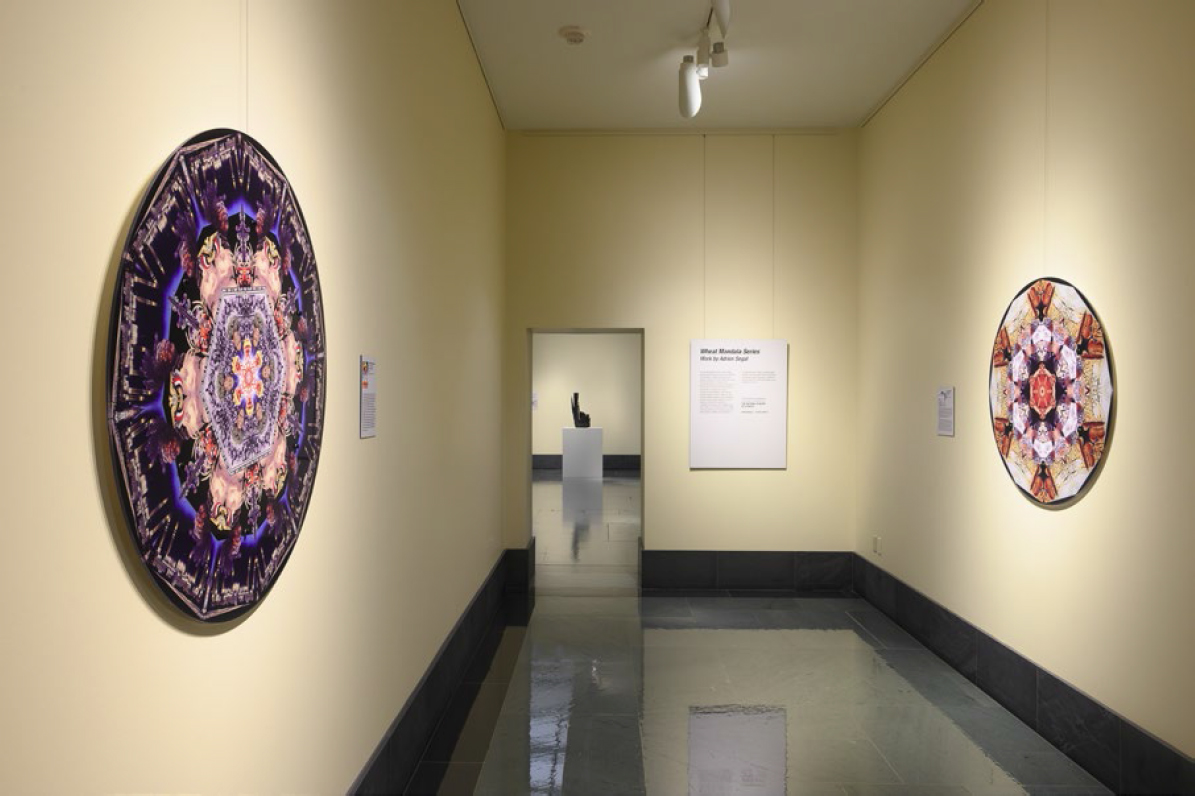
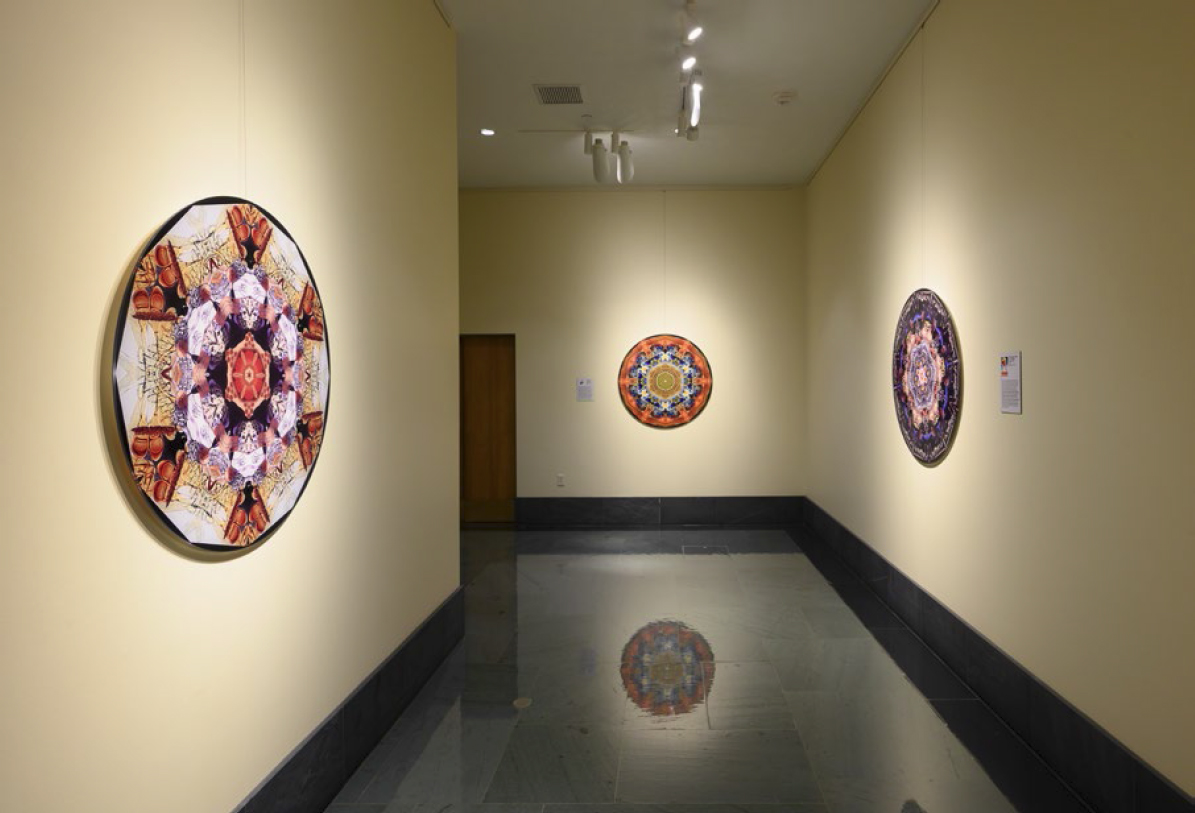
In the Wheat Mandala triptych, Adrien Segal explores narratives that convey the complex and tenuous history of wheat cultivation and its long-term impacts on human culture and society. Themes explored in the prints include agricultural pathogens and genetic modification, famines and the complex human failures that caused them, and significant cultural contributions that resulted, in part, from the volcanic eruption of Mount Tambora in 1815. Through extensive research, Segal compiled an archive of wheat-related imagery, which she carefully composed into a geometric configuration of symbols. The mandala format draws attention to the historic shift from religion and divine intervention to scientific inquiry, and offers a sense of stability and introspection.
To create the works, Segal compiled imagery related to wheat throughout history and across cultures from various resources, in addition to data provided by the Lethbridge Research and Development Centre.
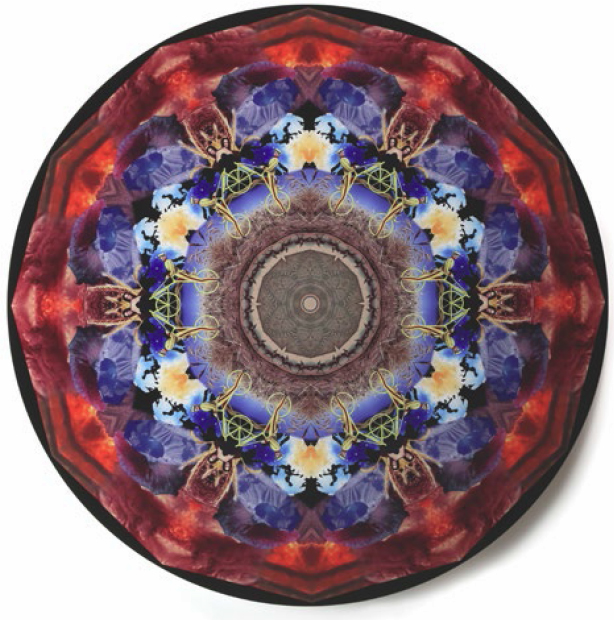
From the Wheat Mandala Series 2018; digital print on acrylic; 40 inch diameter.
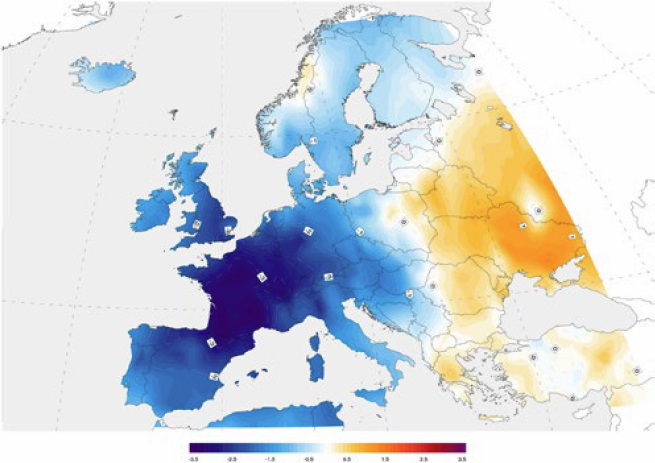
The year 1816 is known as the Year Without a Summer because of severe climate abnormalities caused by the eruption of Mt. Tambora, the largest volcanic eruption in recorded history. Located in present-day Indonesia, its ash was dispersed around the world causing average global temperatures to decrease by .72 – 1.26 °F. The resulting crop failures led to shortages of grain needed to feed horses, inspiring the invention of an early form of a bicycle as an alternative means of transportation. The same summer, the author Mary Shelley, vacationing at Lake Geneva, was forced to stay inside due to the unusually inclement weather. She and her companions had a competition to see who could write the scariest story and her influential novel Frankenstein was the result. Adrien Segal incorporated a climate map of Europe showing the 1816 summer air temperature anomaly, as compared to averages from 1971 to 2000. Visit https://www.adriensegal.com/wheat-mandalas to learn more.
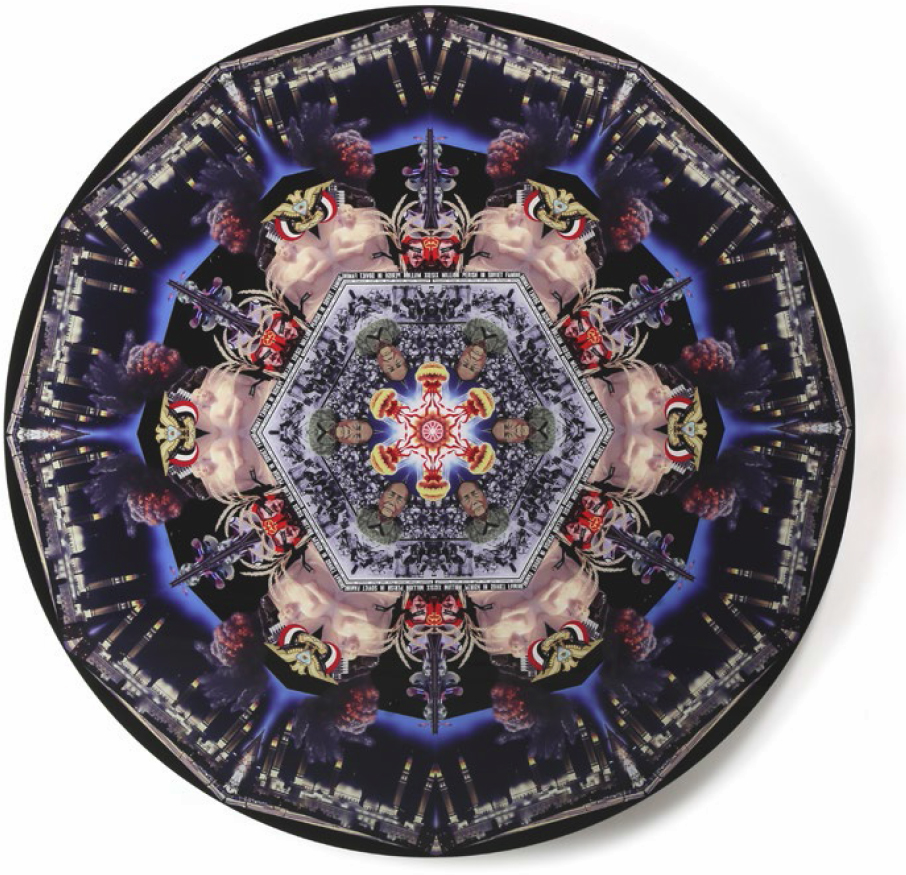
From the Wheat Mandala Series, 2018; digital print on acrylic; 40 inch diameter.
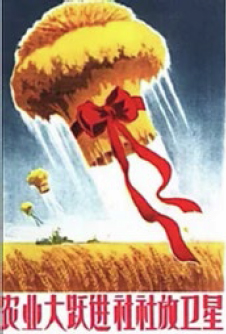
This print represents catastrophic human failures that have resulted in mass famines throughout history, caused by social, economic, and political decisions. Adrien Segal incorporated imagery from this propaganda poster from Chairman Mao’s Great Leap Forward campaign of 1958 that involved mandatory agricultural collectivization, unrealistically high production quotas, and disregard for scientific data, ultimately resulting in the Great Chinese Famine. The propaganda poster was designed to make grain production look like rockets shooting into the sky, when, in reality, between 30 and 55 million citizens died from starvation. It was the deadliest famine in history. Visit https://www.adriensegal.com/wheat-mandalas to learn more.
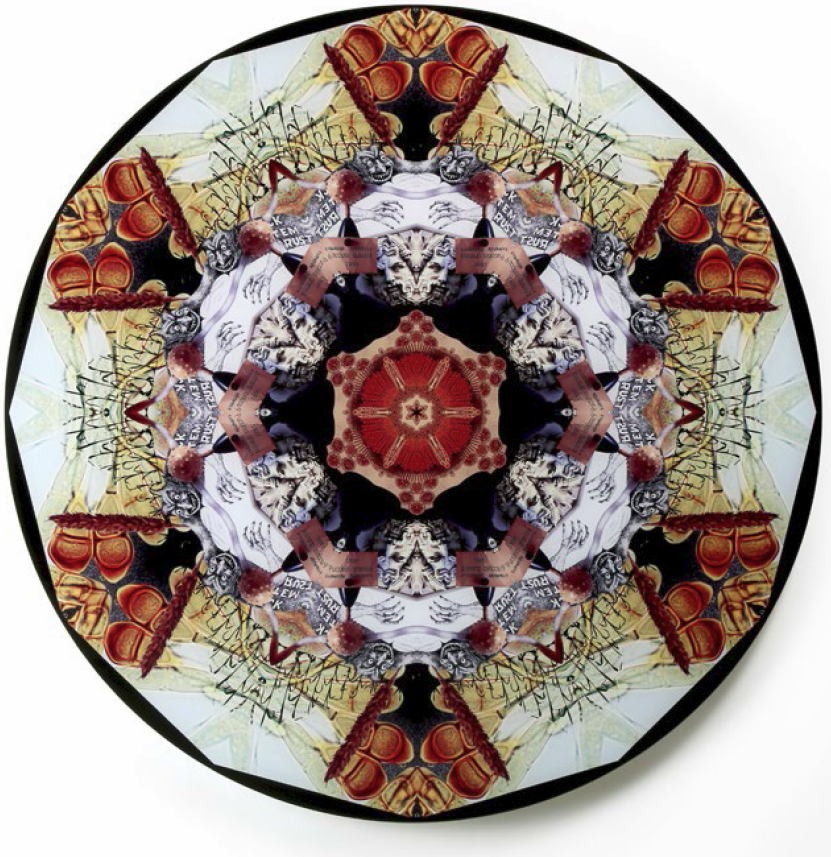
From the Wheat Mandala Series, 2018; digital print on acrylic; 40 inch diameter.
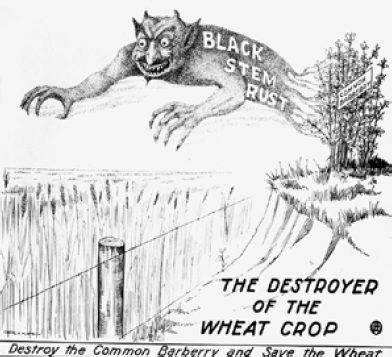
This print shows the many faces of a plant pathogen from the fungi kingdom that causes stripe rust on wheat. Imagery of the Roman god of agricultural disease, scientific models of spores, microscopic views of rust cells, and RNA data used for genetic modification from the Lethbridge Research Center were carefully edited into this circular print.
The narrative is conveyed as a purely visual compilation of digital imagery collected throughout Adrien Segal’s research into the history of wheat and human culture. Visit https://www.adriensegal.com/wheat-mandalas to learn more.