Linkages Between Arctic Warming and Mid-Latitude Weather Patterns: Summary of a Workshop (2014)
Chapter: Appendix C: Table and Schematic Presented by Session 1 Speakers
Appendix C
Table and Schematic Presented by Session 1 Speakers
Session 1 speakers presented the table below as a potential tool for organizing information about what is known and not known about proposed linkages between Arctic warming and mid-latitude weather patterns. The first column is used to describe each linkage. The second column is meant to assess confidence in and strength of linkages by outlining our current scientific understanding of that linkage. The ACID test (Attributable, Corroborated, Informed, Detected) could be incorporated here. The third column is used to identify critical research gaps in observations and models. The first row provides some suggestions on factors to consider. The remaining two rows provide examples.
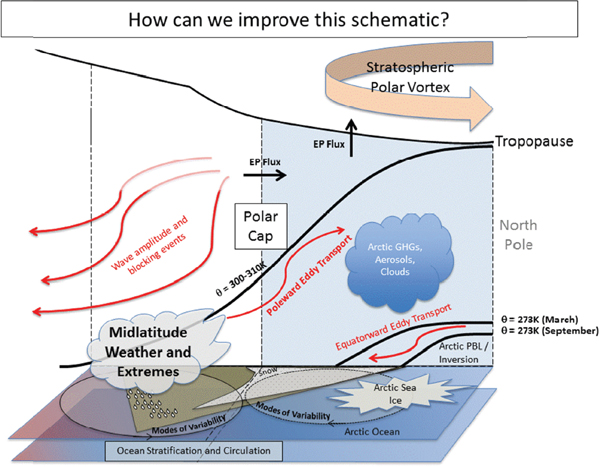
The schematic is illustrative of the big picture questions beyond the scope of the workshop:
- To what does the Arctic respond?
o Changes at the Polar Cap boundary.
o Changes at other boundaries (surface, tropopause, composition of atmospheric column).
- To what does the mid-latitude circulation respond?
o Changes at the Polar Cap boundary.
o Changes at other boundaries (surface, tropopause, subtropical boundary, composition).
| Arctic Linkages: Summary table | ||
|
a. Linkage and Description:
• Timescale (intraseasonal, decadal, …) • Season (JFM, SON, …) • Proposed role of Arctic (direct, through feedbacks, through modes) • Motivation to study (fundamental, forecasting, socioeconomic, ecological) |
b. Current Understanding:
• Basis of evidence (theory, obs, models) • Related linkages, and separability from these linkages • Level of confidence (ACID) • Quantification (e.g. sensitivity factors .M/.A) |
c. Research Gaps:
• Observational capacity • New observational analysis • Modeling capacity • New model experiments and diagnostics • Theoretical knowledge • Impacts analysis |
|
1a. Linkage and Description: Sea ice and mid-latitude wave amplitude events
• Multidecadal trend • Seasonality of response is poorly understood • Proposed to be forced by Arctic amplification; direct Arctic involvement • Connected to mid-latitude weather extremes |
1b. Current Understanding:
• Observational evidence: some in support, some not; metric dependent • Some theoretical arguments in support, but details of dynamical mechanism are lacking. • Related to other implications of polar amplification. • Fundamental problem of signal to noise in analyses • Dynamical mechanism poorly quantified (e.g. seasonality of forcing and response, timescales, amplitude of response) • Attributable – No; Corroborated – No; Informed by mechanisms – Maybe; Detected –No |
1c. Research Gaps:
• Broader observational analysis required involving statistics of extremes. • Simplified model experiments possibly useful. • Studies of CMIP5 require high frequency output. • Long model runs, multiple realizations, required. |
|
2a. Linkage and Description: Eurasian snow/sea ice linkage
• Interannual variability and decadal trends • September sea ice and October snow • Arctic role: direct, through moisture transport |
2b. Current Understanding:
• Difficult to detect clear linkage apart from trends. • Disagreement with trends for different observational datasets • Model support: direct sea ice perturbation experiments • Physically plausible. • ACID assessment: Attributable – in models; Corroborated – Only partially; Informed by mechanisms – Partially; Detected – Partially. |
2c. Research Gaps:
• Need to consolidate climate data records • Need to analyze trends in models and understand connections to moisture transport. |
This page intentionally left blank.


