Winners Selected for the TRB Airport Cooperative Research Program’s 2023-2024 University Design Competition for Addressing Airport Needs
News Release
By guest contributor Paul Mackie
Last update August 26, 2024
WASHINGTON — The Transportation Research Board’s Airport Cooperative Research Program has selected winners for its latest University Design Competition for Addressing Airport Needs. Now in its 18th year, the annual competition encourages students to design innovative and practical solutions to challenges at airports. Four first-place winners were chosen across the four technical challenge areas: Airport Environmental Interactions; Airport Safety, Operations, and Maintenance; Passenger Experience and Innovations in Airport Terminal Design; and Airport Management and Planning. Second- and third-place awards and honorable mentions were also given. The first-place winning teams in each category are:
Airport Environmental Interactions Challenge
Hyomin Cha, Colby Cowley, Adam Freeman, Graeme Johnson, Bradan Penrod, Ethan Robbins, Curtis Van Ausdal, and Brendan Williams from Utah Valley University’s Engineering Department won first place for their proposal titled Autonomous Electric Aircraft Tug. Their faculty adviser was Brett Stone
Airport Safety, Operations, and Maintenance Challenge
Raymond Ayres, Savanna Box, Nicholas M. Buckalew, Jose L. Cabrera Jr., and Anna Golendukhina from Embry-Riddle Aeronautical University’s Aeronautical Sciences Department won first place for their proposal titled Integrating Unmanned Aerial Systems for Enhanced Wildlife Hazard Assessments within Airport Environments. Their faculty adviser was Flávio Mendonca.
Passenger Experience and Innovations in Airport Terminal Design Challenge
Sooyon Jin and Jialong Sun from Purdue University’s School of Aviation and Transportation Technology captured first place for their proposal titled Multifunctional Airport Luggage Cart (The Chariot). Their faculty adviser was Mary Johnson.
Airport Management and Planning Challenge
Owen Hall, Kyle Ketterer, Nathan Leo, Samantha Padamonsky, and Kaleah Tuttle from the School of Engineering Design and Innovation at Pennsylvania State University won first place for their proposal titled Reducing Idle Time via Machine Learning. Their faculty adviser was Meredith Handley.
Additionally, teams from Purdue University, Kent State University, and Pennsylvania State University won second-place awards; teams from University of Dubuque, Virginia Military Institute, and Pennsylvania State University won third-place awards, and teams from Purdue University, Michigan Technological University, Pennsylvania State University, and Wentworth Institute of Technology received honorable mentions.
Students were invited to propose innovations in any of the four technical challenge areas. The competition requires that students work with a faculty adviser and that they reach out to airport operators and industry experts for advice and to assess the practicality of their proposed design solutions. The Virginia Space Grant Consortium in Hampton, Virginia, manages the competition on behalf of the Airport Cooperative Research Program. Funding for the competition is provided by the Federal Aviation Administration. Volunteer panels of airport industry and academic practitioners as well as FAA representatives selected the winning submissions from among proposals submitted by 31 student teams.
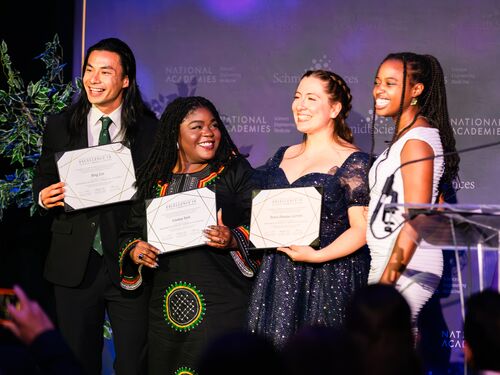
First-place winners received their awards and presented their work at a ceremony at the National Academies of Sciences, Engineering, and Medicine on July 31 (video of the ceremony). They will be given the opportunity to present their winning proposals at an industry professional conference or workshop in fall 2024. Winning teams receive $3,000 for first place, $2,000 for second place, $1,000 for third place, and $500 for honorable mentions.
The names of all winners and copies of designs receiving place awards will be made available at the https://www.trb.org/ACRP/designwinners2024.aspx.
The Airport Cooperative Research Program is an industry-driven, applied research program that develops near-term, practical solutions to airport challenges. The program is managed by the Transportation Research Board, which is a program unit of the National Academies of Sciences, Engineering, and Medicine — private, nonprofit institutions that provide independent, objective analysis and advice to the nation to solve complex problems and inform public policy decisions related to science, engineering, and medicine. The National Academies operate under an 1863 congressional charter to the National Academy of Sciences, signed by President Lincoln. For more information, visit https://national-academies.org.
Contact:
Paul Mackie, Director of Communications/Media
Transportation Research Board
202-841-2953; email PMackie@nas.edu
More like this


Discover
Events
Right Now & Next Up
Stay in the loop with can’t-miss sessions, live events, and activities happening over the next two days.
NAS Building Guided Tours Available!
Participate in a one-hour guided tour of the historic National Academy of Sciences building, highlighting its distinctive architecture, renowned artwork, and the intersection of art, science, and culture.