Coral Reefs, Resilience, and the Stories we Tell
Program News
By Lauren Kalinosky
Last update February 11, 2026
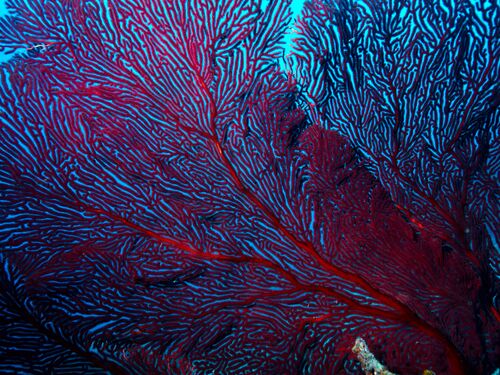
Coral reefs are often described in scientific terms: ecosystems rich in biodiversity, natural storm barriers, and sources of food and income. Yet for many scientists, the path into reef research did not begin with data but with a powerful personal encounter with the natural world.
Andrew Baker, professor and marine biologist at the University of Miami, shared how that spark came early. “Being a child of the 1970s, I grew up with a TV show called Life on Earth. It was all about diversity, about the amazing planet that we had inherited, that had all of these other creatures that shared the planet with us. The idea that we are somehow aboard this ship, travelling through space, full of this amazing menagerie of organisms, kind of like Noah’s Ark, really captured my imagination as a kid,” he recalled.
Katie Cramer, associate research professor at Arizona State University, found her inspiration seeing rapid environmental change firsthand. Growing up in Phoenix, she watched familiar landscapes and ecosystems shift before her eyes as development expanded. “It made me wonder, what impacts were humans having before I was even born?” she said. That question continues to be central to her work reconstructing the historical ecology of coral reefs and interpreting long-term environmental change.
These reflections were shared during a Climate Conversation hosted this past spring by the National Academies, where Andrew and Katie joined moderator Maiya May, co-host of the PBS climate podcast Weathered, to discuss how personal memory and narrative shape scientific understanding and public engagement with climate-related issues. Maiya shared that David Attenborough’s nature documentaries inspired her own interest in storytelling to build deeper connections to nature on our shared planet.
For many communities, coral reefs hold significance far beyond their ecological roles. “In Hawaiian culture, their creation story explains that life began with a coral polyp, and all subsequent lives therefore came from corals,” Katie noted. Such stories highlight the deep connections of coral reefs to shared histories, economies, and knowledge systems— dimensions that complement scientific understanding.
Today, however, coral reefs face unprecedented threats from warming oceans and acidification. “Heat stress is becoming a really severe factor,” Andrew explained. “There’s really very few, if any, areas of the world’s reefs that haven’t experienced a major bleaching event.” He described the challenge to save reefs as “three balls to juggle at the moment: climate change, local stressors, and interventions to try to increase the heat resistance of corals.”
Speaking about current restoration strategies, Andrew explained that among the most promising interventions are efforts to harness natural diversity. Scientists are selectively breeding corals that have survived past bleaching events and introducing heat-tolerant algal symbionts inside coral tissue to improve their survival under warming conditions. He pointed to work in Florida, where collaborations across international boundaries are expanding genetic diversity in restoration efforts. While these new interventions offer promising restoration tools, Andrew emphasized that technology alone won’t save the reefs.
Andrew also highlighted the importance of new narratives to drive action. In South Florida, his team uses science-based storytelling to build support for reef protection. Coral reefs, he explained, provide protective function by helping buffer coastlines from storm surge and flooding. By absorbing up to 97% of wave energy, breaking up larger waves, and stabilizing sediment, corals reduce the force of incoming waves and significantly lessen erosion and flood risk.
“We have a tremendous amount of built infrastructure that is very close to the shoreline,” he said. “Studies have shown that the natural systems off that shoreline are worth hundreds of millions of dollars a year in avoided damages. That can affect things like insurance premiums and the reinsurance industry.” He noted that hybrid reef approaches, which combine natural and engineered systems, could further boost this protective value.
Framing reefs as protective assets has the power to attract investment and shape policymaking. But economic benefits, while vital, are only one piece of the puzzle. Andrew insists: “It’s also about working with stakeholders to get people to understand the value that reefs bring. Beyond their biodiversity and beauty, they have tremendous societal value.”
Maiya echoes this, describing storytelling as a bridge between complex climate science and daily life: “[On the podcast], we connect how coral reef decline affects people’s lives. If we can improve the communication and overall education, the public will be more likely to demand the programs and policy we need.”
Katie adds that visual storytelling can make that connection tangible. Seeing historical photos of thriving reefs, “like a Dr. Suess seascape,” helped her imagine what restoration can still achieve.
Despite the losses, both Andrew and Katie emphasized hope. “We still have something amazing out there,” Andrew reflected. “I worry we might look back in the 2060s, and say, ‘Gosh, if only we could have the reefs of the 2020s now, what we wouldn’t give to have those reefs.’ And here we are in the 2020s. We can’t lose hope.” Katie added that corals have persisted through millions of years of environmental change, suggesting resilience remains possible.
For science communicators, the challenge is to be honest about the change without yielding to despair. Storytelling helps people connect emotionally, envision solutions, and stay engaged. Andrew returns to the image that first inspired him: “Every time we imagine a future where we have, through mismanagement or underappreciation, allowed that Ark to become less diverse, to lose species that we can never get back… that’s a tremendous loss of the human spirit.”
Saving coral reefs will require science, conservation, and restoration— but it’s stories that can turn awareness into action. They remind us that coral reefs are not just ecosystems, but a part of who we are.
Featured Project
Climate Conversations: Pathways to Action
Seminar/Webinar/Lecture
Climate Conversations: Pathways to Action is a regular virtual event series that aims to convene high-level, cross-cutting, nonpartisan conversations about issues relevant to action on climate change.
More like this
Discover
Events
Right Now & Next Up
Stay in the loop with can’t-miss sessions, live events, and activities happening over the next two days.
NAS Building Guided Tours Available!
Participate in a one-hour guided tour of the historic National Academy of Sciences building, highlighting its distinctive architecture, renowned artwork, and the intersection of art, science, and culture.